
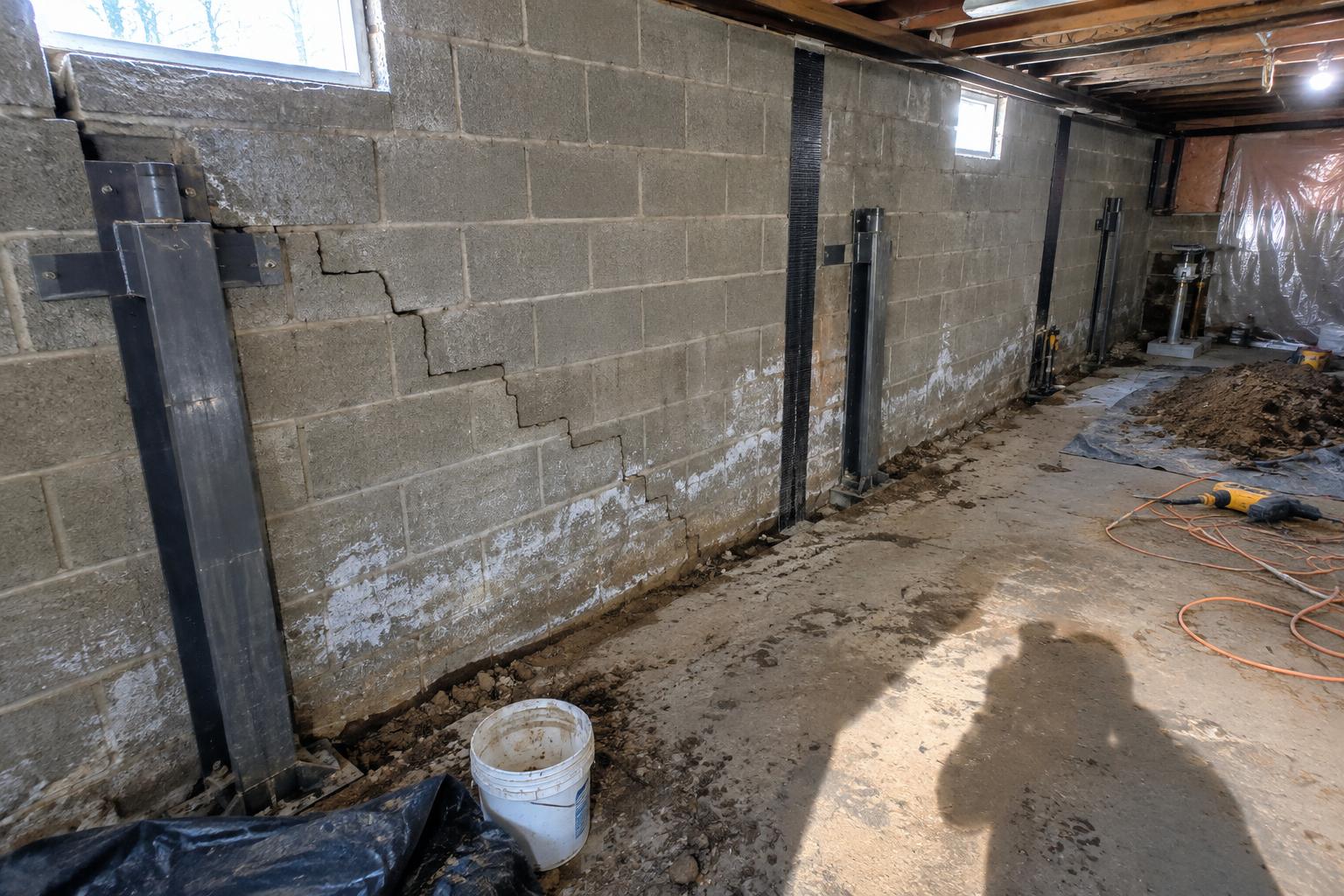
If you own a home in Williams Creek, you probably know the soil here does not sit still. The ground under these older, established properties is mostly glacial clay and till. That clay holds water in a wet spring, then pulls back and shrinks when the weather turns dry. Over years of swelling and shrinking, the soil pushes and pulls on a foundation until something gives. A hairline crack widens. A basement wall leans in a little. A corner of the house settles lower than the rest.
None of this means your home is falling down. It does mean the foundation is telling you something, and the sooner you listen, the simpler the fix tends to be.
Why Williams Creek foundations move
The neighborhoods around Williams Creek have a lot of homes built decades ago, with poured concrete walls and block basements, plus some crawl spaces under additions and older sections. The clay around them reacts hard to central Indiana weather. Heavy spring rain saturates the soil and adds hydrostatic pressure against the walls. Then winter brings freeze-thaw cycles, where water in the ground freezes, expands, and heaves, then melts and settles again.
Block walls feel this pressure first. You often see a horizontal crack running along the middle courses, or a stair-step crack following the mortar joints. Poured walls tend to crack vertically or at the corners. On the settlement side, doors that stick, gaps over window frames, and sloping floors usually point to soil moving under a footing rather than pressure on the wall.
Signs it is time for a closer look
Some clues are easy to spot once you know them. Walk your basement or crawl space in good light and look for these.
- Cracks wider than about an eighth of an inch, especially if they grow - A wall that bows inward or leans at the top - White mineral staining or damp patches after rain - Doors and windows that bind or will not latch - Floors that tilt or feel bouncy in one area
One or two small cracks in an older home are common. The thing to track is change. A crack that keeps opening, a wall that keeps leaning, or water that shows up every spring is worth a professional set of eyes. You can read more about foundation repair in Williams Creek and how we approach each type of problem.
How the repair actually works
The right repair depends on what the foundation is doing. We do not guess. We measure the wall, check for movement, and look at the soil and drainage around the house before we recommend anything.
For bowing or leaning walls, the usual answers are carbon fiber straps or steel I-beams for moderate movement, or wall anchors that reach into stable soil out in the yard and pull the wall back over time. For a wall that has moved a lot, excavation to relieve pressure may come first.
For settlement, we use steel piers. Push piers or helical piers drive down past the soft clay to firmer soil or bedrock, then transfer the weight of the house onto that stable layer. Once they are set, we can often lift the settled section back toward its original position.
Water drives most of this, so drainage is part of the job. That can mean interior drain tile, a sump pit and pump, regrading soil away from the house, or fixing downspouts that dump next to the foundation. In homes with a crawl space, controlling moisture matters just as much as the walls.
The crawl space factor
Plenty of Williams Creek homes have a crawl space under part of the structure. Damp crawl spaces let humidity rise into the house, encourage wood rot, and can hide support problems you never see from upstairs. Sagging floors over a crawl space often trace back to failing supports or soft, wet soil below.
We handle supports, vapor barriers, drainage, and sealing as part of Crawl Space Repair. A dry, supported crawl space keeps the whole house steadier and the indoor air healthier.
Why acting early pays off
Foundation problems rarely fix themselves, and the clay around here does not get kinder with time. A wall with a small bow is far easier and less costly to stabilize than one that has moved several inches. Early piers can often lift a house back close to level, while long neglected settlement may only be stabilized in place.
A proper inspection gives you a clear picture. You learn what is moving, why, and what it would take to stop it. From there you can plan, instead of waiting for the next wet spring to make the decision for you. Call us at 317-251-1935 to set up a look at your home.